Best Dropshipping Product Research Tools 2026: The Complete Comparison

Grant Myers | Founder & CEO, EcomSpy AI
Feb 15, 2026
15 Minutes
Shopify Spy Tools
Grant Myers | Founder & CEO, EcomSpy AI
Feb 15, 2026
15 Minutes
Shopify Spy Tools
Introduction:
If you’ve been dropshipping for more than five minutes, you’ve already felt the pain of “product research overload.”
One person tells you to scroll social feeds for hours. Another tells you to copy whatever’s trending. Someone else insists you need five subscriptions and three spreadsheets just to pick a product.
And the worst part is that even after all that, you still don’t know the most important thing: whether people are buying this product right now from real stores, and whether the demand is strong enough to survive your first round of tests.
That’s why the conversation about the best dropshipping product research tools in 2026 needs to be more honest.
A “product research tool” can mean a lot of things. Some tools are built to help you discover products. Some help you find ads and creative angles. Some help you validate demand by looking at store-level performance signals and traffic patterns.
If you treat all tools as interchangeable, you’ll waste money and time.
Stop guessing and start validating.
Introduction:
If you’ve been dropshipping for more than five minutes, you’ve already felt the pain of “product research overload.”
One person tells you to scroll social feeds for hours. Another tells you to copy whatever’s trending. Someone else insists you need five subscriptions and three spreadsheets just to pick a product.
And the worst part is that even after all that, you still don’t know the most important thing: whether people are buying this product right now from real stores, and whether the demand is strong enough to survive your first round of tests.
That’s why the conversation about the best dropshipping product research tools in 2026 needs to be more honest.
A “product research tool” can mean a lot of things. Some tools are built to help you discover products. Some help you find ads and creative angles. Some help you validate demand by looking at store-level performance signals and traffic patterns.
If you treat all tools as interchangeable, you’ll waste money and time.
Stop guessing and start validating.
What “Best” Means for Dropshipping Product Research in 2026
The best tool isn’t the one with the most features. The best tool is the one that helps you make better decisions, faster, without feeding you noise.
In 2026, a tool is worth paying for if it consistently helps you answer questions like these:
Can I prove demand instead of assuming it?
If the only “signal” you have is that a product looks cool, you don’t have a signal. You have a hunch.
Real signals show up as search intent, repeatable traffic patterns, and stores that keep selling the product after the first wave of attention.
Can I understand where buyers come from?
A product can look “hot” while being propped up by one short-lived traffic source.
When you can see traffic sources and keyword visibility, you can spot whether demand is durable or fragile.
Can I tell if it’s saturated in the places I want to sell?
Saturation isn’t just “a lot of competitors exist.”
Saturation is when your offer can’t compete on angle, differentiation, or economics because the market is crowded and buyers have already seen the same thing repeatedly.
Can I move from idea to validation in one session?
Manual research is slow because it forces you to jump between tabs: product pages, ads, search results, store themes, and spreadsheets.
The best tools reduce context switching and make your next decision obvious.
The 5 Types of Dropshipping Product Research Tools (and What They’re Actually For)
Most “best tools” lists mix everything together. That’s how people end up paying for the wrong tool and blaming themselves when it doesn’t work.
Here are the categories that matter, and what each one is best at.
Store Analytics and Shopify Brand Intelligence Tools
This is the category that most directly answers the question: “Are real stores succeeding with this product or niche?”
Instead of starting with a product and hoping it sells, you start with evidence.
You analyze stores and brands, look at performance signals, and work backward into products, positioning, and angles.
What this category is best for
Store analytics tools are best when you want to validate winners and avoid dead ends.
They help you confirm demand, understand traffic drivers, see which countries are responding, and spot patterns across trending stores.
Where EcomSpy AI wins in 2026
EcomSpy AI is built for this validation step.
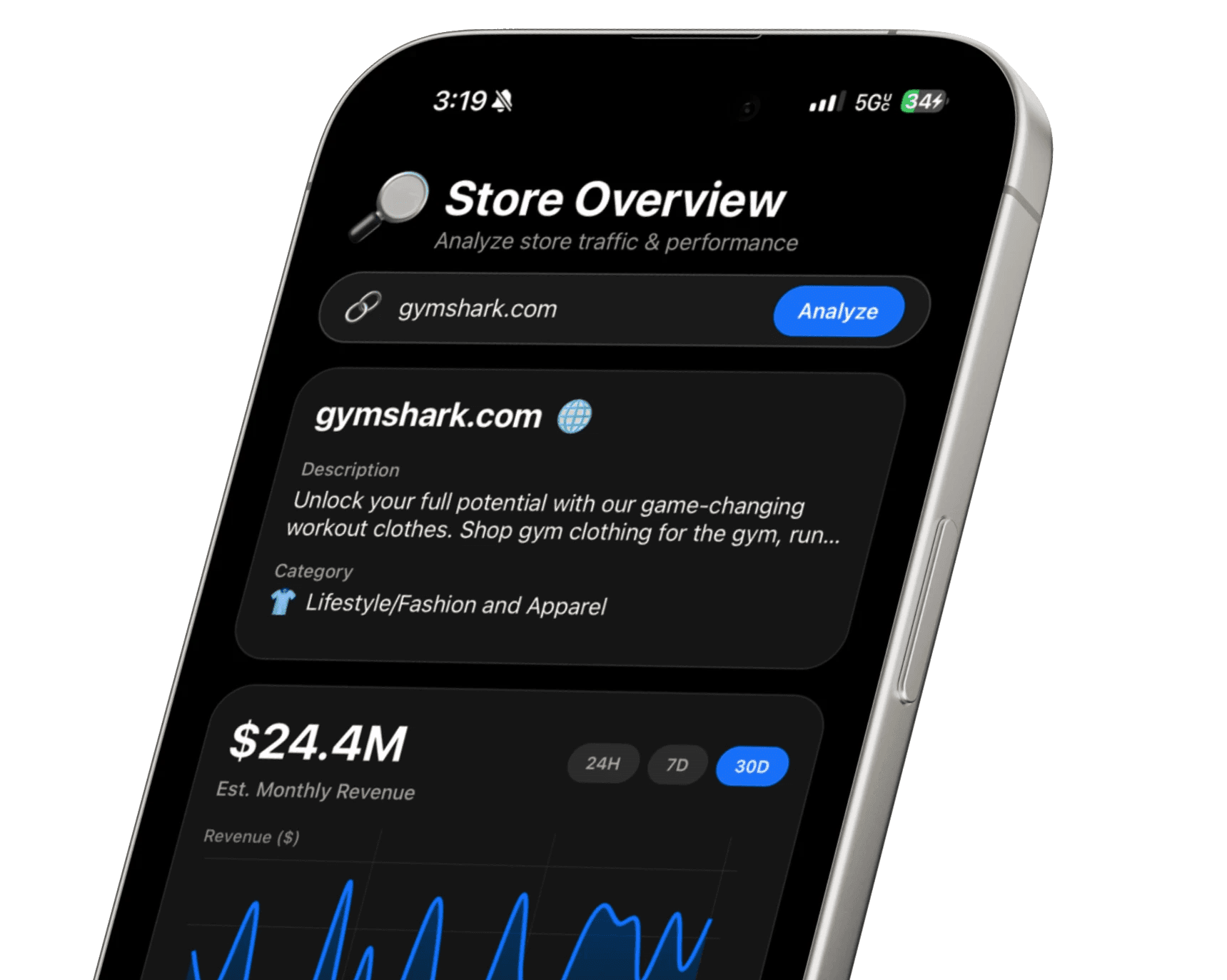
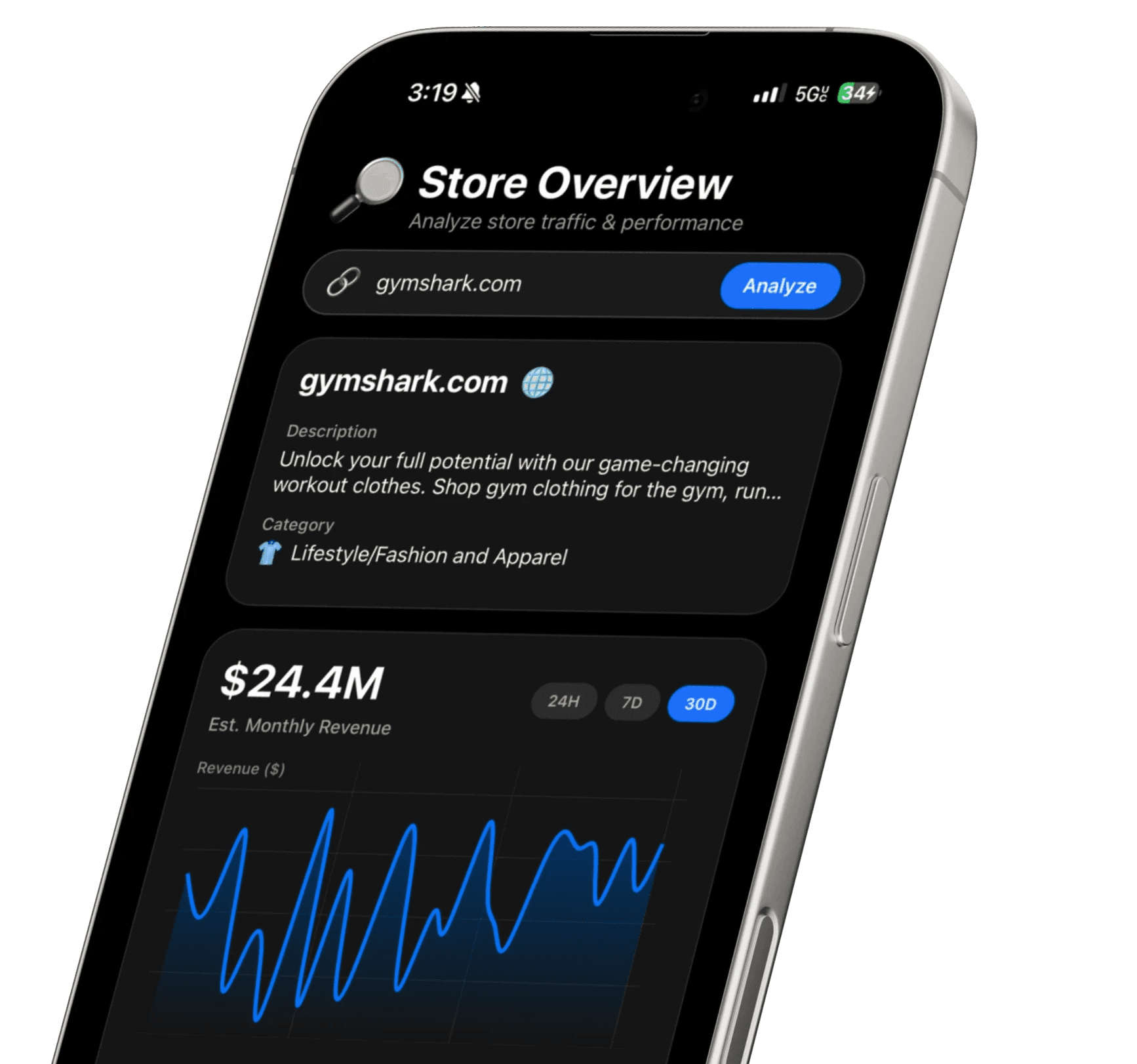
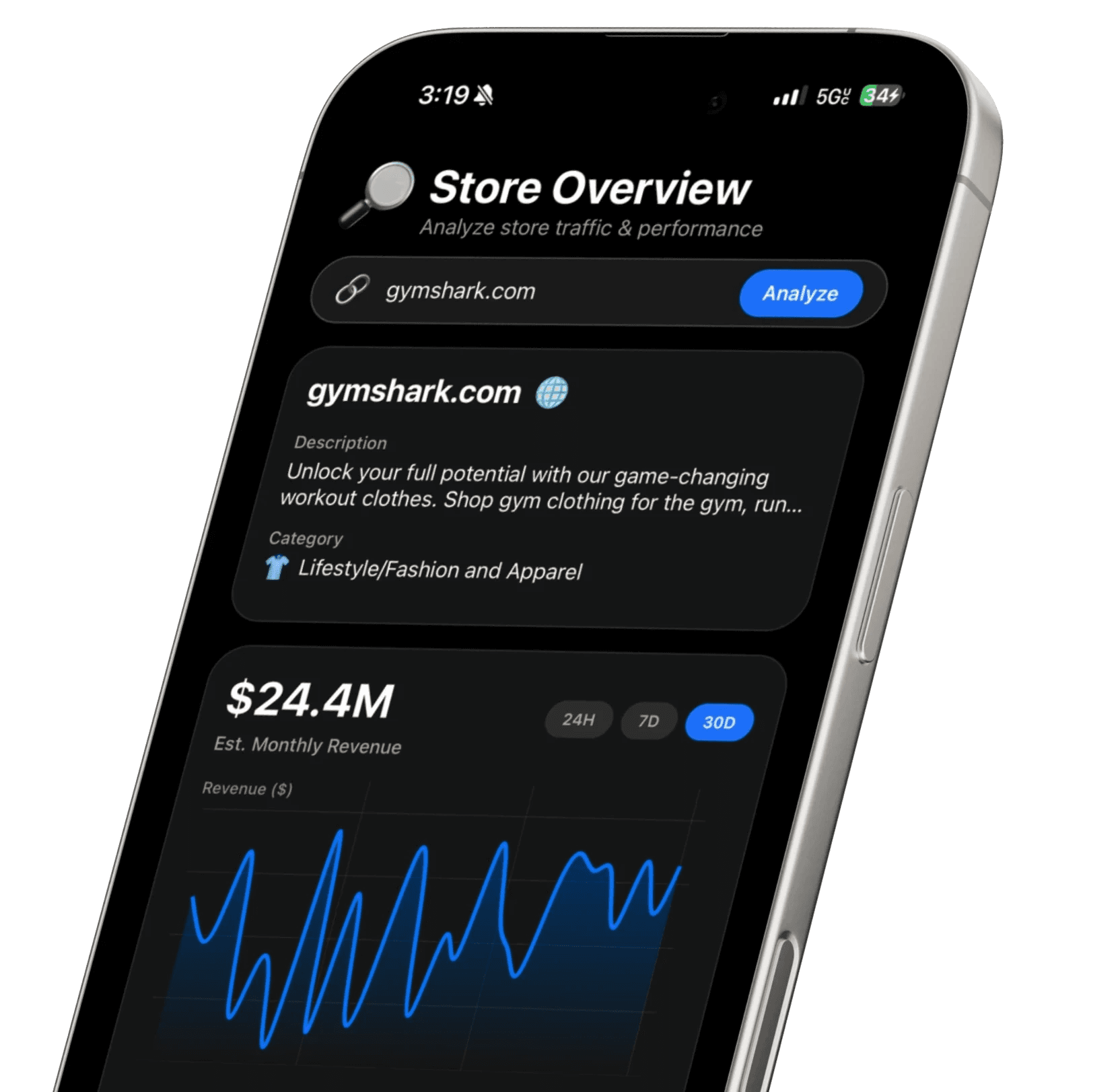
You can analyze stores and brands using revenue and sales performance insights, traffic insights (visitors, sources, countries, and top keywords), store overview analytics, trending Shopify brands, AI chat to answer questions about any store, and unlimited tracking history.
That combination matters because most dropshippers don’t fail from lack of ideas. They fail from picking ideas without validation.
The “two-hour trap” EcomSpy AI helps you avoid
A common manual workflow looks like this: you see a product, you hunt down a few stores selling it, you try to guess whether those stores are actually doing well, then you spiral into tabs and screenshots.
You feel productive, but you didn’t confirm anything.
With EcomSpy AI, you’re validating through store-level signals and traffic patterns instead of vibes.
You’re not relying on what a store looks like. You’re relying on what the store attracts.
2) Ad Discovery and Creative Research Tools
This category focuses on what’s being promoted and how it’s being marketed.
These tools can be useful for discovering new angles, seeing how products are pitched, and understanding creative patterns that get attention.
Platforms like Minea position themselves as ad discovery tools across multiple networks and promote finding products through ad activity.
What this category is best for
Ad discovery is best for creative inspiration and positioning research.
It’s often where you’ll see trends early, because marketers push aggressively when something starts converting.
Where this category can mislead you
Ads can show effort, not results.
A product can have lots of ads because it’s easy to test, not because it’s profitable.
That’s why ad discovery works best when it’s paired with validation.
If you find a product from ads, you still need to confirm that stores selling it are attracting real buyer demand and not just burning spend.
The right way to use ad discovery in 2026
Treat ads as “leads,” not proof.
Use ads to understand hooks and creatives.
Then validate with store analytics and traffic insights to decide whether the niche is worth your time.
3) Curated “Winning Product” Databases and Trend Lists
This category includes tools that curate products for you, usually with commentary, targeting suggestions, and sometimes supplier links.
Ecomhunt is an example of a platform that presents curated product research features and product lists for ecommerce sellers.
What this category is best for
These tools are best for beginners who want a starting point.
They’re also useful when you need ideas fast and you don’t want to start from scratch.
The tradeoff
When everyone sees the same curated list, you’re competing with people who saw it at the same time you did.
The product can still work, but your differentiation matters more.
This is another place where validation becomes the edge.
If you can quickly confirm where demand is coming from, which countries are reacting, and which keywords are driving visits to stores, you can build a smarter offer than someone who simply copies the idea.
The “list-to-launch” filter
If you use curated lists, you need a filter step before you build a store page.
Your filter should answer: “Is this niche getting consistent buyer-intent traffic right now?”
Store analytics and traffic intelligence are the cleanest way to apply that filter.
4) Marketplace and Retail Research Tools (Amazon, AliExpress, etc.)
This is the classic “manual research” lane: browsing marketplaces, checking bestsellers, scanning reviews, and trying to spot patterns.
Amazon openly encourages sellers to look at fast-moving lists like Movers & Shakers as a way to generate product ideas.
What this category is best for
Marketplace research is great for understanding what people buy, what they complain about, and what features matter.
Reviews are a goldmine for copywriting because they reveal pain points in plain language.
The limitation
Marketplaces don’t automatically tell you whether a product is a fit for Shopify dropshipping economics.
A product can sell well on a marketplace and still struggle for you if the shipping profile, competition, or acquisition costs don’t work.
The smart marketplace workflow
Use marketplaces for idea generation and positioning insights.
Then validate on the Shopify side by analyzing stores and how they attract traffic.
If you can’t find stores successfully selling the product with meaningful traffic signals, you should pause before building.
5) Keyword and Search Demand Tools
Even in 2026, search intent is one of the most reliable signals you can find because it captures what people are actively looking for.
Keyword tools help you answer: “Are people searching for this product, and what language do they use when they’re close to buying?”
What this category is best for
Keyword tools are great for naming your product, writing SEO content, and building collections around intent.
The limitation
Search tools can show interest, but they don’t show which stores are capturing that interest.
That’s the gap most dropshippers feel.
They can find keywords, but they can’t tell whether stores are turning that attention into real performance.
This is where EcomSpy AI becomes a force multiplier: you can connect keyword language to store traffic patterns and actual store behavior.
The Real Comparison: Manual Product Research vs. EcomSpy AI Workflow
A lot of “tool comparisons” are actually feature lists.
That’s not how real dropshippers choose tools.
What matters is the workflow.
So here’s a more honest comparison: what you do manually, and what changes when you validate through store analytics and traffic intelligence.
Manual research workflow (what most people do)
You start with ideas.
You scroll.
You search marketplaces.
You watch what’s being promoted.
You open a bunch of stores.
You screenshot.
You try to guess whether a store is doing well by how professional it looks, how many reviews it has, or how many comments an ad got.
Sometimes you’re right. Often you’re not.
And because the process is slow, you end up testing fewer ideas.
Testing fewer ideas means you have fewer chances to find a winner.
The EcomSpy AI workflow (what changes)
You still start with ideas, but you move to validation faster.
You pick a niche or product angle, then use EcomSpy AI to analyze stores selling similar items.
You check traffic sources, keyword visibility, and country breakdowns.
You look at store overview analytics to understand what kind of brand you’re dealing with.
You use AI chat to ask focused questions like:
Which products appear to be driving attention?
What pages are most important in this store’s structure?
Which countries are sending the most traffic?
Which keywords are consistently associated with this store?
Instead of building on assumptions, you build on signals.
Why this matters for conversion
When your product choice is backed by traffic and store signals, your messaging gets sharper.
Your offer becomes more specific.
Your creatives become more believable.
And your tests become cleaner, because you’re not trying to force a random product into a random niche.
How to Choose the Best Dropshipping Product Research Tool Stack (Based on Your Stage)
Most people buy tools based on fear.
They think more subscriptions equals more certainty.
A better approach is to match tools to your stage.
Stage 1 — New store, need product ideas and a validation system
If you’re early, you need two things: a way to generate ideas quickly, and a way to validate them without lying to yourself.
In this stage, curated product databases and manual marketplace research are fine for discovery.
But you need a validation tool that keeps you from building around products that don’t have durable demand.
This is where EcomSpy AI fits immediately.
It turns “maybe” into “worth testing” by showing you store-level signals and traffic intelligence.
Stage 2 — You can run ads, but you keep picking products that don’t scale
If you’ve launched a few products and none of them hold, the issue is rarely your ability to run ads.
It’s usually that your product selection is too random, or you’re choosing products that are already overexposed without enough differentiation.
At this stage, ad discovery tools can help you spot creative angles, but EcomSpy AI is what helps you answer the deeper question: “Is this niche actually working across stores, and where is the buyer demand coming from?”
Stage 3 — You have some winners and you want repeatable product discovery
Once you have traction, the game becomes systematic.
You want to find adjacent winners, spot trending Shopify brands early, and keep a watchlist of stores and niches so you’re not starting from zero every month.
Unlimited tracking history becomes a real advantage here because it lets you compare performance patterns over time instead of treating every week like a brand new world.
The “portfolio mindset”
In 2026, the best dropshippers don’t bet the business on one product.
They build a portfolio of tests.
Tools that help you validate faster help you run that portfolio smarter.
Why EcomSpy AI Is the Best Choice for Shopify Dropshippers in 2026
A lot of tools are good at discovery.
Fewer tools are good at validation.
And validation is what prevents you from wasting your next month.
EcomSpy AI is designed to answer the questions that actually matter before you commit budget and time.
It connects product ideas to store reality
Instead of arguing about whether a product “seems hot,” you can analyze stores that sell similar products and look at performance and traffic signals.
It shows traffic insights that matter for buyer intent
Understanding traffic sources and top keywords gives you leverage.
You can tell whether demand is primarily search-driven, content-driven, or coming from a narrow channel.
That changes how you launch.
It helps you focus on what’s trending in Shopify specifically
General “trending product” lists can be useful, but Shopify trends behave differently than marketplace trends.
EcomSpy AI’s focus on trending Shopify brands helps you align with how Shopify shoppers discover products and how Shopify stores grow.
It speeds up research with AI chat
Most tools make you hunt for answers.
AI chat lets you ask direct questions and move on.
When you’re researching multiple stores, this alone can save you hours per week.
The practical result
You spend less time collecting screenshots and more time making decisions you can defend.
A Simple, Repeatable Product Research Process You Can Use Every Week
This is the process I recommend if you want consistency without drowning in tools.
Start with a short list of themes, not random products
Themes can be seasonal, problem-based, or audience-based.
The point is to avoid chasing anything that looks shiny.
Use one discovery source, then validate immediately
Pick your discovery source for the day: a curated list, marketplace browsing, or ad discovery.
Pull three product candidates, not thirty.
Then validate those candidates by analyzing stores in that niche with EcomSpy AI.
Look at traffic sources, keywords, and geography.
If the signals aren’t there, move on.
Build offers around what the data suggests, not what you hope is true
If store traffic shows a niche is search-heavy, your product page needs clarity and comparison.
If it’s content-heavy, your creatives need demonstration.
If it’s country-specific, your targeting and shipping messaging need to match.
The win is not finding “the one”
The win is turning product selection into a system that produces testable ideas every week.
Common Mistakes When Choosing Product Research Tools in 2026
Even smart dropshippers fall into these traps.
Buying tools that solve the same problem
If two tools both give you product lists, you didn’t build a stack.
You doubled down on discovery and ignored validation.
Confusing ads with demand
Seeing ads means marketers are testing.
It doesn’t automatically mean the niche is profitable.
Skipping the Shopify-specific validation step
A product can be popular in one ecosystem and weak in another.
If you’re a Shopify dropshipper, validating through Shopify store behavior matters.
Over-relying on “trend” language
Trends are useful, but they’re not a strategy.
Your strategy is validation, differentiation, and economics.
What “Best” Means for Dropshipping Product Research in 2026
The best tool isn’t the one with the most features. The best tool is the one that helps you make better decisions, faster, without feeding you noise.
In 2026, a tool is worth paying for if it consistently helps you answer questions like these:
Can I prove demand instead of assuming it?
If the only “signal” you have is that a product looks cool, you don’t have a signal. You have a hunch.
Real signals show up as search intent, repeatable traffic patterns, and stores that keep selling the product after the first wave of attention.
Can I understand where buyers come from?
A product can look “hot” while being propped up by one short-lived traffic source.
When you can see traffic sources and keyword visibility, you can spot whether demand is durable or fragile.
Can I tell if it’s saturated in the places I want to sell?
Saturation isn’t just “a lot of competitors exist.”
Saturation is when your offer can’t compete on angle, differentiation, or economics because the market is crowded and buyers have already seen the same thing repeatedly.
Can I move from idea to validation in one session?
Manual research is slow because it forces you to jump between tabs: product pages, ads, search results, store themes, and spreadsheets.
The best tools reduce context switching and make your next decision obvious.
The 5 Types of Dropshipping Product Research Tools (and What They’re Actually For)
Most “best tools” lists mix everything together. That’s how people end up paying for the wrong tool and blaming themselves when it doesn’t work.
Here are the categories that matter, and what each one is best at.
Store Analytics and Shopify Brand Intelligence Tools
This is the category that most directly answers the question: “Are real stores succeeding with this product or niche?”
Instead of starting with a product and hoping it sells, you start with evidence.
You analyze stores and brands, look at performance signals, and work backward into products, positioning, and angles.
What this category is best for
Store analytics tools are best when you want to validate winners and avoid dead ends.
They help you confirm demand, understand traffic drivers, see which countries are responding, and spot patterns across trending stores.
Where EcomSpy AI wins in 2026
EcomSpy AI is built for this validation step.
You can analyze stores and brands using revenue and sales performance insights, traffic insights (visitors, sources, countries, and top keywords), store overview analytics, trending Shopify brands, AI chat to answer questions about any store, and unlimited tracking history.
That combination matters because most dropshippers don’t fail from lack of ideas. They fail from picking ideas without validation.
The “two-hour trap” EcomSpy AI helps you avoid
A common manual workflow looks like this: you see a product, you hunt down a few stores selling it, you try to guess whether those stores are actually doing well, then you spiral into tabs and screenshots.
You feel productive, but you didn’t confirm anything.
With EcomSpy AI, you’re validating through store-level signals and traffic patterns instead of vibes.
You’re not relying on what a store looks like. You’re relying on what the store attracts.
2) Ad Discovery and Creative Research Tools
This category focuses on what’s being promoted and how it’s being marketed.
These tools can be useful for discovering new angles, seeing how products are pitched, and understanding creative patterns that get attention.
Platforms like Minea position themselves as ad discovery tools across multiple networks and promote finding products through ad activity.
What this category is best for
Ad discovery is best for creative inspiration and positioning research.
It’s often where you’ll see trends early, because marketers push aggressively when something starts converting.
Where this category can mislead you
Ads can show effort, not results.
A product can have lots of ads because it’s easy to test, not because it’s profitable.
That’s why ad discovery works best when it’s paired with validation.
If you find a product from ads, you still need to confirm that stores selling it are attracting real buyer demand and not just burning spend.
The right way to use ad discovery in 2026
Treat ads as “leads,” not proof.
Use ads to understand hooks and creatives.
Then validate with store analytics and traffic insights to decide whether the niche is worth your time.
3) Curated “Winning Product” Databases and Trend Lists
This category includes tools that curate products for you, usually with commentary, targeting suggestions, and sometimes supplier links.
Ecomhunt is an example of a platform that presents curated product research features and product lists for ecommerce sellers.
What this category is best for
These tools are best for beginners who want a starting point.
They’re also useful when you need ideas fast and you don’t want to start from scratch.
The tradeoff
When everyone sees the same curated list, you’re competing with people who saw it at the same time you did.
The product can still work, but your differentiation matters more.
This is another place where validation becomes the edge.
If you can quickly confirm where demand is coming from, which countries are reacting, and which keywords are driving visits to stores, you can build a smarter offer than someone who simply copies the idea.
The “list-to-launch” filter
If you use curated lists, you need a filter step before you build a store page.
Your filter should answer: “Is this niche getting consistent buyer-intent traffic right now?”
Store analytics and traffic intelligence are the cleanest way to apply that filter.
4) Marketplace and Retail Research Tools (Amazon, AliExpress, etc.)
This is the classic “manual research” lane: browsing marketplaces, checking bestsellers, scanning reviews, and trying to spot patterns.
Amazon openly encourages sellers to look at fast-moving lists like Movers & Shakers as a way to generate product ideas.
What this category is best for
Marketplace research is great for understanding what people buy, what they complain about, and what features matter.
Reviews are a goldmine for copywriting because they reveal pain points in plain language.
The limitation
Marketplaces don’t automatically tell you whether a product is a fit for Shopify dropshipping economics.
A product can sell well on a marketplace and still struggle for you if the shipping profile, competition, or acquisition costs don’t work.
The smart marketplace workflow
Use marketplaces for idea generation and positioning insights.
Then validate on the Shopify side by analyzing stores and how they attract traffic.
If you can’t find stores successfully selling the product with meaningful traffic signals, you should pause before building.
5) Keyword and Search Demand Tools
Even in 2026, search intent is one of the most reliable signals you can find because it captures what people are actively looking for.
Keyword tools help you answer: “Are people searching for this product, and what language do they use when they’re close to buying?”
What this category is best for
Keyword tools are great for naming your product, writing SEO content, and building collections around intent.
The limitation
Search tools can show interest, but they don’t show which stores are capturing that interest.
That’s the gap most dropshippers feel.
They can find keywords, but they can’t tell whether stores are turning that attention into real performance.
This is where EcomSpy AI becomes a force multiplier: you can connect keyword language to store traffic patterns and actual store behavior.
The Real Comparison: Manual Product Research vs. EcomSpy AI Workflow
A lot of “tool comparisons” are actually feature lists.
That’s not how real dropshippers choose tools.
What matters is the workflow.
So here’s a more honest comparison: what you do manually, and what changes when you validate through store analytics and traffic intelligence.
Manual research workflow (what most people do)
You start with ideas.
You scroll.
You search marketplaces.
You watch what’s being promoted.
You open a bunch of stores.
You screenshot.
You try to guess whether a store is doing well by how professional it looks, how many reviews it has, or how many comments an ad got.
Sometimes you’re right. Often you’re not.
And because the process is slow, you end up testing fewer ideas.
Testing fewer ideas means you have fewer chances to find a winner.
The EcomSpy AI workflow (what changes)
You still start with ideas, but you move to validation faster.
You pick a niche or product angle, then use EcomSpy AI to analyze stores selling similar items.
You check traffic sources, keyword visibility, and country breakdowns.
You look at store overview analytics to understand what kind of brand you’re dealing with.
You use AI chat to ask focused questions like:
Which products appear to be driving attention?
What pages are most important in this store’s structure?
Which countries are sending the most traffic?
Which keywords are consistently associated with this store?
Instead of building on assumptions, you build on signals.
Why this matters for conversion
When your product choice is backed by traffic and store signals, your messaging gets sharper.
Your offer becomes more specific.
Your creatives become more believable.
And your tests become cleaner, because you’re not trying to force a random product into a random niche.
How to Choose the Best Dropshipping Product Research Tool Stack (Based on Your Stage)
Most people buy tools based on fear.
They think more subscriptions equals more certainty.
A better approach is to match tools to your stage.
Stage 1 — New store, need product ideas and a validation system
If you’re early, you need two things: a way to generate ideas quickly, and a way to validate them without lying to yourself.
In this stage, curated product databases and manual marketplace research are fine for discovery.
But you need a validation tool that keeps you from building around products that don’t have durable demand.
This is where EcomSpy AI fits immediately.
It turns “maybe” into “worth testing” by showing you store-level signals and traffic intelligence.
Stage 2 — You can run ads, but you keep picking products that don’t scale
If you’ve launched a few products and none of them hold, the issue is rarely your ability to run ads.
It’s usually that your product selection is too random, or you’re choosing products that are already overexposed without enough differentiation.
At this stage, ad discovery tools can help you spot creative angles, but EcomSpy AI is what helps you answer the deeper question: “Is this niche actually working across stores, and where is the buyer demand coming from?”
Stage 3 — You have some winners and you want repeatable product discovery
Once you have traction, the game becomes systematic.
You want to find adjacent winners, spot trending Shopify brands early, and keep a watchlist of stores and niches so you’re not starting from zero every month.
Unlimited tracking history becomes a real advantage here because it lets you compare performance patterns over time instead of treating every week like a brand new world.
The “portfolio mindset”
In 2026, the best dropshippers don’t bet the business on one product.
They build a portfolio of tests.
Tools that help you validate faster help you run that portfolio smarter.
Why EcomSpy AI Is the Best Choice for Shopify Dropshippers in 2026
A lot of tools are good at discovery.
Fewer tools are good at validation.
And validation is what prevents you from wasting your next month.
EcomSpy AI is designed to answer the questions that actually matter before you commit budget and time.
It connects product ideas to store reality
Instead of arguing about whether a product “seems hot,” you can analyze stores that sell similar products and look at performance and traffic signals.
It shows traffic insights that matter for buyer intent
Understanding traffic sources and top keywords gives you leverage.
You can tell whether demand is primarily search-driven, content-driven, or coming from a narrow channel.
That changes how you launch.
It helps you focus on what’s trending in Shopify specifically
General “trending product” lists can be useful, but Shopify trends behave differently than marketplace trends.
EcomSpy AI’s focus on trending Shopify brands helps you align with how Shopify shoppers discover products and how Shopify stores grow.
It speeds up research with AI chat
Most tools make you hunt for answers.
AI chat lets you ask direct questions and move on.
When you’re researching multiple stores, this alone can save you hours per week.
The practical result
You spend less time collecting screenshots and more time making decisions you can defend.
A Simple, Repeatable Product Research Process You Can Use Every Week
This is the process I recommend if you want consistency without drowning in tools.
Start with a short list of themes, not random products
Themes can be seasonal, problem-based, or audience-based.
The point is to avoid chasing anything that looks shiny.
Use one discovery source, then validate immediately
Pick your discovery source for the day: a curated list, marketplace browsing, or ad discovery.
Pull three product candidates, not thirty.
Then validate those candidates by analyzing stores in that niche with EcomSpy AI.
Look at traffic sources, keywords, and geography.
If the signals aren’t there, move on.
Build offers around what the data suggests, not what you hope is true
If store traffic shows a niche is search-heavy, your product page needs clarity and comparison.
If it’s content-heavy, your creatives need demonstration.
If it’s country-specific, your targeting and shipping messaging need to match.
The win is not finding “the one”
The win is turning product selection into a system that produces testable ideas every week.
Common Mistakes When Choosing Product Research Tools in 2026
Even smart dropshippers fall into these traps.
Buying tools that solve the same problem
If two tools both give you product lists, you didn’t build a stack.
You doubled down on discovery and ignored validation.
Confusing ads with demand
Seeing ads means marketers are testing.
It doesn’t automatically mean the niche is profitable.
Skipping the Shopify-specific validation step
A product can be popular in one ecosystem and weak in another.
If you’re a Shopify dropshipper, validating through Shopify store behavior matters.
Over-relying on “trend” language
Trends are useful, but they’re not a strategy.
Your strategy is validation, differentiation, and economics.
Frequently Asked Questions
What are the best dropshipping product research tools in 2026?
The best tools depend on what you need.
Discovery tools help you find ideas, while validation tools help you confirm whether a niche is actually working.
A strong 2026 setup usually combines one discovery method (curated lists, marketplace browsing, or ad discovery) with a store analytics tool like EcomSpy AI to validate products using traffic insights, keyword visibility, and store-level performance signals.
Why do most “winning product” lists feel unreliable?
Because they often stop at ideas.
Ideas are cheap.
What matters is whether real stores are successfully selling similar products and attracting buyer-intent traffic.
Without validation, lists tend to lead to copycat launches and faster saturation.
How do I validate a product before spending money on ads?
Validate by analyzing stores in the niche.
Look for consistent traffic patterns, meaningful keywords that suggest buying intent, and signals that demand isn’t coming from just one short-lived channel.
EcomSpy AI is built for this step because it surfaces store analytics and traffic intelligence quickly.
Are ad discovery tools enough to find winning products?
Ad discovery tools are great for creative inspiration and early trend spotting, but ads alone don’t prove durable demand.
The strongest workflow is to use ads as a lead source, then validate the niche by analyzing stores and how they attract traffic.
What’s the fastest way to find winning products consistently in 2026?
Run a repeatable loop: discover a small set of candidates, validate with store analytics and traffic insights, launch a focused test, then track results and refine.
Consistency comes from speed plus validation, not from collecting more product ideas than you can test.
Conclusion:
If you’re trying to choose the best dropshipping product research tools in 2026, the most important shift is this: stop paying only for discovery, and start building around validation.
Discovery helps you find possibilities.
Validation tells you what’s worth building.
That’s why EcomSpy AI is the best fit for Shopify dropshippers who want to make smarter product decisions faster.
When you can analyze stores with revenue and sales performance insights, traffic insights (sources, countries, top keywords), store overview analytics, trending Shopify brands, AI chat, and unlimited tracking history, you’re not guessing anymore.
You’re choosing products based on signals you can defend.
If you want a research workflow that feels calm instead of chaotic, make EcomSpy AI your validation step.
Use it to confirm demand, understand where buyers come from, and spot trends early—then turn that clarity into faster launches and better tests.
Blogs
Check Out Other Articles
Discover how our powerful tools make managing money simpler, faster, and smarter.
Blogs
Check Out Other Articles
Discover how our powerful tools make managing money simpler, faster, and smarter.
Blogs
Check Out Other Articles
Discover how our powerful tools make managing money simpler, faster, and smarter.

Download EcomSpy AI Now For Free
Join thousands of business owners already using EcomSpy AI to research and validate winning products.
Bank-Level Security
No Hidden Fees
Cancel Anytime

Download EcomSpy AI Now For Free
Join thousands of business owners already using EcomSpy AI to research and validate winning products.
Download EcomSpy AI Now For Free
Join thousands of business owners already using EcomSpy AI to research and validate winning products.